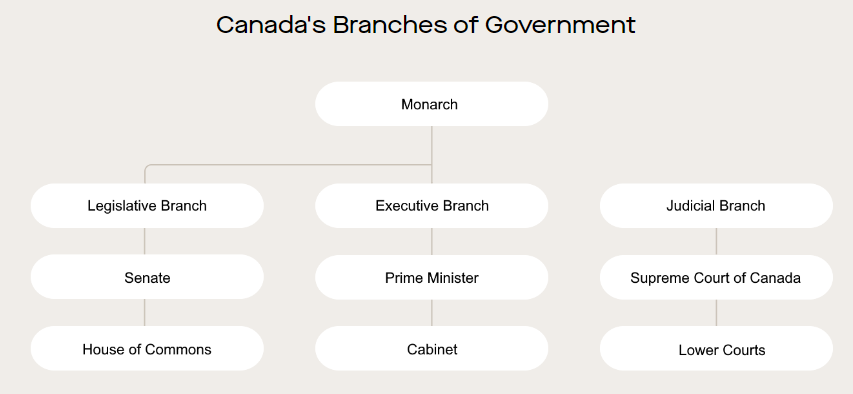
There are three branches to the Federal Government:
Legislative
Executive
Judicial
Legislative
- Comprised of the House of Commons (HOC) and the Senate.
- HOC functions are to consider through debate new laws and changes to existing ones, authorize taxes, and provide scrutiny of the policy and expenditure of the Government. It has the power to give a Government a vote of no confidence.
- HOC is made up of MPs that are voted in by the public
- Each MP represents a riding (voting area) and is a member of a political party
- What are the “Big 5” political parties in the HOC?
- Liberal
- Conservative
- NDP
- Green
- Bloc Quebecois
- Senators are appointed by the governor general until the age of 75
- The Senate tends to be more impartial than the Commons and is more likely to agree on issues.
- It also often has more opportunity to study proposed bills in detail ("sober second thought") and this allows it to make many small improvements to legislation before its final reading.
- Minor changes proposed by the Senate to a bill are usually accepted.
- The House of Commons in practice holds far more power than the Senate.
- Although the approval of both Houses is necessary for legislation, the Senate very rarely rejects bills passed by the Commons (though the Senate does occasionally amend bills)
Judicial (Supreme Court)
- The highest court of law in Canada
- Consists of nine justices, which include the Chief Justice of Canada (as of 2021, held by The Right Honourable Richard Wagner)
- The court's duties include hearing appeals of decisions and, on occasion, delivering the court's opinion on constitutional questions raised by the federal government.
- By law, three of the nine justices are appointed from Quebec because of Quebec's use of civil law.
- In 1949, Parliament passed an amendment to the Supreme Court Act which abolished all appeals, making the Court truly the Supreme Court
Executive
- Consists of the Prime Minister, Cabinet, Governor General, and Monarch (Head of State)
- The PM is usually the head of the political party in power and is the head of the government.
- They are not voted in by the public, but are appointed by the Governor General on behalf of the monarch
- Prime Ministers do not have a fixed term
- Prime Ministers who are not Members of Parliament upon their appointment (or who lose their seats while in office) have since been expected to seek election to the HOC as soon as possible.
- Should a sitting PM today lose his or her seat in the legislature, or should a new PM be appointed without holding a seat, the typical process that follows is that a junior member in the governing political party will resign to allow the PM to run in the resulting by-election
- A prime minister earns a salary of $203,100 (as of 2024), plus the normal salary of a Member of Parliament ($203,100) for a total of $406,200.
- Cabinet is chosen by the PM and appointed by the Governor General, making them members of the King’s Privy Council
- There are a number of conventions that are expected be followed. For instance, there is typically a minister from each province in Canada, ministers from visible minority groups, and female ministers
- Contains committees headed by a senior minister: Treasury Board, Priorities and Planning Committee, Operations, Social Affairs, Economic Growth and Long-Term Prosperity, Foreign Affairs and Security, Environment and Energy Security
- Governor General is the federal representative of the monarch, currently King Charles III.
- Appointed by the monarch on the advice of the PM to carry out most of his constitutional and ceremonial duties.
- Guarantor of continuous and stable governance and as a nonpartisan safeguard against the abuse of power
- Provides royal assent for bills in parliament